
The Multi-Agent Debate Circus
How AI Researchers Learned to Stop Worrying and Love the Groupthink Hustle

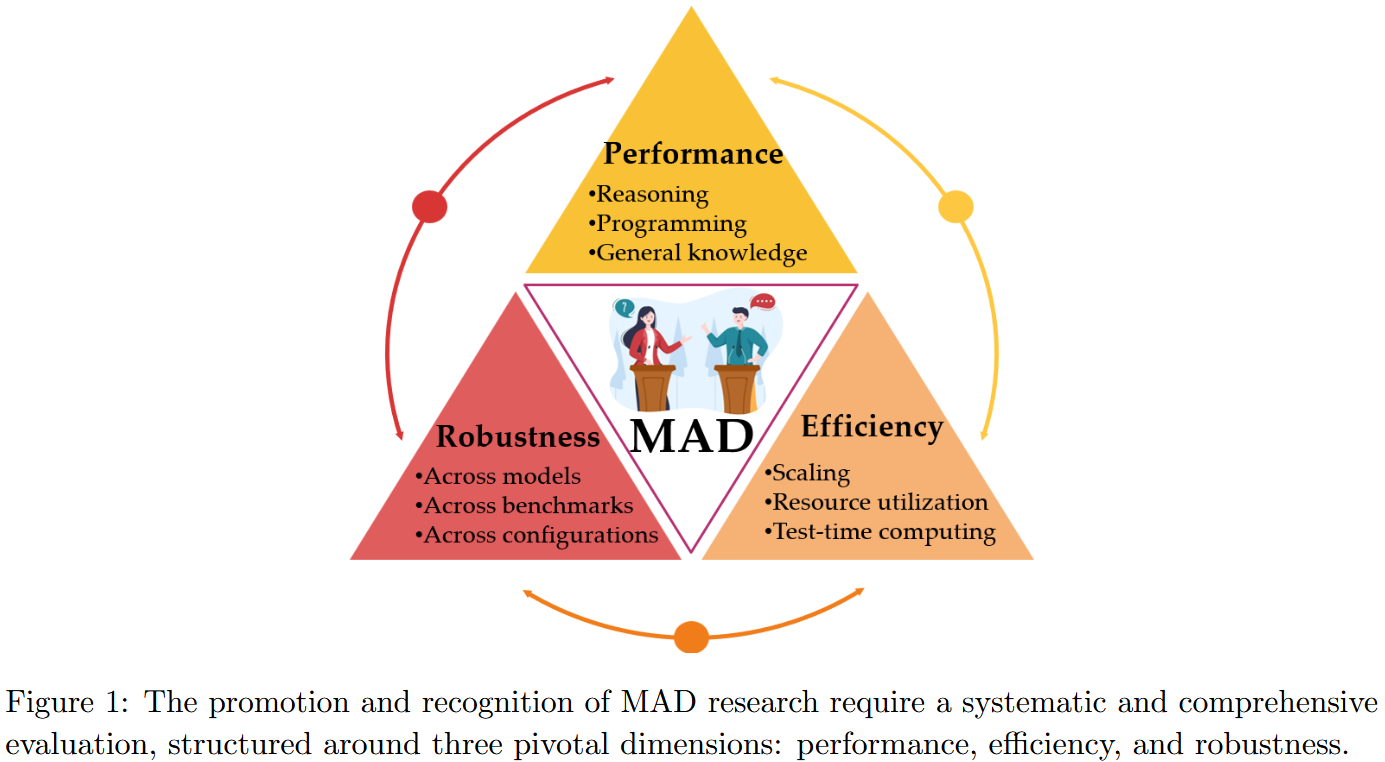
The artificial intelligence community has a fetish for metaphors. We’ve anthropomorphized silicon into “agents,” baptized matrix multiplication as “attention,” and now, in a fit of collective delirium, decided that large language models—statistical autocomplete engines trained on the digital detritus of humanity—should debate each other. Welcome to the show: Multi-Agent Debate (MAD), the latest performative ritual in the endless quest to pretend that scaling parameters and grinding GPUs will birth genuine intelligence. The premise is simple, if laughably naive: if you make enough LLMs argue like overcaffeinated philosophy undergrads, their consensus will somehow transcend their individual stupidity. A new preprint, dripping with the obligatory humility of academic understatement, finally asks the obvious question: Does this actually work? Spoiler: no. But the real story here isn’t the failure—it’s the spectacle of an entire research subfield sprinting headlong into a hall of mirrors, mistaking their own reflections for progress.
The MADness of Crowds: When Collaboration Becomes Computational Cosplay
The original MAD proposition was seductive in its simplicity. Instead of relying on a single LLM to bumble through a problem, why not deploy an army of identical clones to argue it out? One agent plays the optimist, another the contrarian; they exchange passive-aggressive rebuttals in a structured dance of synthetic discourse, then vote on the “best” answer. Early papers reported modest gains on tasks like math problems and code generation, and the community pounced. Conferences ballooned with MAD variants: Society of Mind, Multi-Persona, Exchange-of-Thoughts—each more baroque than the last, like generative AI’s answer to the Council of Nicaea.
But the new study eviscerates this narrative. After evaluating five MAD frameworks across nine benchmarks and four base models, the results are grim: MAD methods failed to outperform single-agent Chain-of-Thought prompting in 80% of scenarios. Even when researchers ramped up the computational heft—more agents! More debate rounds! More tokens burned!—the returns diminished faster than a crypto bro’s portfolio. The ANOVA tests tell the tale: across 36 experimental conditions, not a single MAD variant achieved a win rate above 20% against the humble CoT. The emperor isn’t just naked; he’s been paraded through the village square while villagers politely cough into their hands.
The Homogeneity Trap: Why All LLMs Sound Like Your Boring Uncle at Thanksgiving
Why does MAD flounder? The answer lies in a fundamental oversight: homogeneity. Current MAD systems deploy agents spawned from the same base model—GPT-4 clones debating other GPT-4 clones, like a Reddit thread where every commenter shares a single brain. Unsurprisingly, this leads to opinion cascades, where agents rapidly converge on whatever half-baked intuition the base model favors. The preprint’s authors demonstrated this by tweaking one variable: letting agents sample from a pool of heterogeneous models (GPT-4, Claude, PaLM, etc.). Suddenly, MAD’s performance spiked—not because the debates improved, but because introducing actual diversity forced agents to confront alternatives to their echo chamber.
This finding should’ve been predictable. Human debates yield insight precisely because participants bring divergent priors, expertise, and cognitive biases. But in the LLM realm, “debate” is just a probabilistic parrot squawking the same phrase in slightly different accents. The study’s Heter-MAD approach works not through some grand synthesis of perspectives, but by brute-forcing variation into a system pathologically averse to it. It’s less Socratic dialogue and more slot machine: keep pulling the lever until a different model coughs up a passable answer.
The Efficiency Charade: Computational Waste as a Badge of Honor
Let’s address the elephant in the server room: MAD is ludicrously inefficient. A typical MAD setup might use 5 agents conducting 3 debate rounds, totaling 15 LLM calls per query. For comparison, Self-Consistency—a simpler single-agent method that samples multiple reasoning paths—achieves better results with 10 calls. The preprint quantifies this embarrassment: when controlling for compute budget, MAD underperformed Self-Consistency by 12-18% across mathematical reasoning tasks.
But inefficiency isn’t a bug—it’s a feature. The AI research economy thrives on methods that are computationally grotesque, because scale excuses failure. If your 175B-parameter model flops, just throw more agents at it! The paper dryly notes that “none of the evaluated MAD methods considered token efficiency as a design constraint”, which is academic code for “we’re burning through VC funding faster than Sam Bankman-Fried at a Key Party.”
The Replication Crisis No One Wants to Talk About
Deeper into the preprint, a more insidious pattern emerges: evaluation arbitrage. MAD papers tend to test their shiny new framework on a custom benchmark—often one kept under wraps—while ignoring established datasets. When the authors replicated experiments across standardized benchmarks like MMLU and HumanEval, MAD’s performance gaps widened. Worse, many studies compare MAD against strawman baselines (e.g., vanilla prompting) while ignoring strong contenders like CoT or Self-Consistency. This isn’t science; it’s a cargo cult where researchers ritualistically cite “improvements” without grounding them in reproducible baselines.
The coup de grâce comes from the AgentVerse framework, which dynamically adjusts debate structures based on intermediate results. Sounds clever—until you learn it underperforms static debates 63% of the time. The paper attributes this to “overfitting to synthetic debate dynamics”, a polite way of saying the method optimized for the aesthetic of rigor rather than actual problem-solving.
A Path Forward (or: How to Pretend We’re Not All Clowning Ourselves)
To their credit, the authors resist nihilism. Their Heter-MAD tweak—letting agents tap diverse models—offers a lifeline, boosting performance by 7-14% across tasks. But this “solution” merely papers over MAD’s foundational rot. True progress would require grappling with uncomfortable truths:
Debate ≠ Intelligence. LLMs don’t “reason” through dialectics; they pattern-match prompts into statistically plausible outputs. MAD is a Rube Goldberg machine built atop this reality—a performance of reasoning, not its embodiment.
Benchmarks Are Broken. When GSM8K (grade school math) and HumanEval (trivial coding) pass for “hard” tasks, the field’s standards have decayed into self-parody.
Efficiency Matters. A method that requires 10x more compute for marginal gains isn’t progress—it’s a prelude to architectural collapse.
The paper concludes with a call for “broader community conversation”, but let’s translate that from academese: We’ve built a subfield on quicksand, and it’s time to stop pretending otherwise. MAD won’t die, of course—the allure of anthropomorphic frameworks is too strong, and grant cycles demand novelty. But perhaps this study will curb the worst excesses, or at least inspire researchers to hide their shame when, yet another MAD variant fails to beat CoT. Until then, the debate rages on—a cacophony of agents arguing past each other, while the rest of us facepalm in unison.
Paper: If Multi-Agent Debate is the Answer, What is the Question?